Certification
Are you about to commence your first certification? Or are you considering switching to a new certification body to get a pair of fresh eyes to look at your existing setup?
We help both small, medium-sized and large companies. Even though Bureau Veritas is a world-leading player within certification and accredited by more than 30 different accreditation bodies, including DANAK (Denmark), UKAS (UK) and ANAB (USA), we are good at adapting our processes to the companies we meet.
Our independent subsidiary, Bureau Veritas Denmark A/S, offers a wide range of certification services in areas such as:
- Quality management: ISO 9001 certification
- Environmental management: ISO 14001 certification
- Occupational health and safety management: ISO 45001 certification
- Energy management: ISO 50001 certification
- Cybersecurity management: ISO 27001 certification
With more than 60 accreditations, we can provide accredited certification locally in all countries.
- Management System Certification: ISO 9001, ISO 13485, ISO 22000, FSSC 22000, ISO 14001, ISO 50001, ISO 45001, ISO 55001, ISO 27001, ISO 27701, ISO 22301
- Certification of products: BRCGS, IFS Food, IFS Logistics, IFS Broker, GlobalG.A.P., ASC Farm, MSC CoC, RSPO, Construction Products Standards (e.g. concrete, cement, aggregate, asphalt, insulation)
- Verifications - Greenhouse gases: EU ETS (CO2), ISO 14064-1/-2
In addition to the above, we also offer certifications without accreditation on a wide range of certification schemes - often under an approval from another authority or private owner. E.g. ISO 29001, IATF 16949, DS 21001, AQAP 2110, Electricity, Plumbing and Gas, Renewable Energy and the BedreBolig (better housing) scheme.
OUR ADVICE TO YOU?
Make an effort to find the right certification body, because a good start and good cooperation are alpha omega for effective and result-producing certifications. You are welcome to have a chat with us - without any obligations.
HOW A CERTIFICATION WORKS
It often begins with an external demand, e.g. from a customer, an authority or an important business partner. But for most companies, it does not end here. A certification from Bureau Veritas is far more than "a piece of paper".
The right certification can be a lever for better operational processes, increased efficiency, improved customer and employee satisfaction. It gives new opportunities, but it also creates a structure which makes a noticeable difference in everyday life.
When the audit is completed, we often get the same response: It is not the certificate itself, but the insight our experienced auditors bring into the business that provides the greatest value - both here-and-now and in the long term.
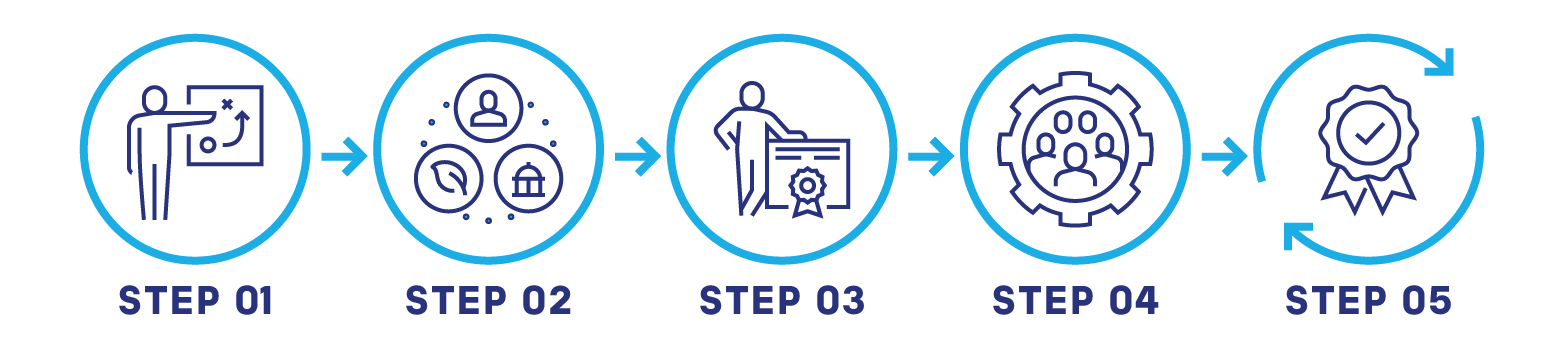
The certification process step-by-step
STEP 1: Initial audit
We start by assessing whether your management system meets the requirements of the standard by reviewing the documentation and your practices. This includes a review of the system's structure, your internal audits (if you have any) and the management's evaluation. Finally, we let you know if you are ready for the main audit or not. The purpose of the initial audit is to ensure that the foundation is suitable.
In 2015, a High Level Structure was introduced for all ISO standards. It outlines the requirements that must be met for certification in the standard – and if this is your first time seeking certification, we recommend starting with a GAP analysis. It provides a clear overview of where the 'gaps' are in meeting the requirements and helps make the work more focused.

step 2: Main Audit
At the main audit, we assess whether your management system meets the mandatory requirements of the standard in question. It is a thorough review where we look at how you have implemented the system in practice, we identify possible bottlenecks and risks and ensure that these are incorporated in the audit programme. All main audits are begun and concluded with a meeting with management. At the final meeting, you get a clear picture of the conclusions in the audit report. The report, prepared by the auditor in charge, contains strengths, improvement opportunities and possible non-conformities. Non-conformities must be closed before a certification can be issued.
step 3: Correction on non-conformities and issuing of certificate(s)
When we assess that all requirements in the standard are met, and possible non-conformities have been handled with corrective actions, your certificate is issued. This is a formal recognition that your management system is robust, well-documented and implemented in practice. The certificate is valid for three years, provided that the system is continuously maintained and complied with. It includes information on the certification scope, the standard used, the certificate expiry date and, if applicable, the covered sites. All documentation, including audit reports, non-conformities and certificates, will be available in our online system.
step 4: Surveillance audit
After certification, the ongoing work of keeping the system operational and compliant with the standard begins. This is carried out through for instance internal audits and during our surveillance audit. The audits take place either semi-annually or annually, depending on your wishes. We check whether your management system still meets the requirements, and whether it works in practice. The surveillance audit is less extensive than the main audit, but important for maintaining the certification and ensuring continuous improvement.
step 5: Re-certification
When the certification period is about to expire, we carry out a re-certification. It is reminiscent of the surveillance audit with document review and a thorough assessment of the management system. If the requirements are still met, a new certificate is issued – and the certification cycle continues.
Would you like to change certification body? You can easily switch without starting over
Even if you are already certified by another certification body, we can take over your certificate. We assess your existing documentation and audit reports, conduct a visit and then we issue a new certificate with the same expiry date as the old one. The certification cycle continues unchanged – but now with fresh eyes and new value from Bureau Veritas.
WHY OTHERS CHOOSE TO BE CERTIFIED
- Control of processes
A certified management system gives you an overview and structure. It minimises errors, reduces waste, and makes it easier to react quickly when requirements or conditions change. - Trust from customers and partners
With a recognised certification, you show that you live up to international standards – and that creates trust. You appear more professional, reliable and ready to take on larger tasks. - Access to new markets and contracts
Many clients – especially large companies and the public sector – require a certification to invite you to the table at all. A certification opens doors. - Financial benefits
Many companies find that a certification leads to lower costs because your management improves and errors decrease. And when the quality is high and stable, customer loyalty and earnings increase. - Motivated employees
A clear system and clear goals create security and commitment. A certification strengthens the working environment, improves collaboration and makes it easier to retain and develop employees.
CEO
Inrotech A/S
"We have created a quality management system that is based on the individual employee, and it is not a "top down" system. All employees are continuously involved in developing the management system, which is an active tool on a daily basis for instance when we communicate with our customers"
FAQ - frequently asked questions
-
What is a certification?
A certification is an independent assessment of whether a company lives up to a given standard. It is visible proof that you work systematically with e.g. quality, the environment or the working environment, and it creates trust with customers, authorities and partners.
-
Why get certified?
For many, it is about being able to document what they already do and at the same time use the certification as a lever for improvements. Others choose certification because it is a customer requirement or a ticket to new markets.
-
How long does it take to get certified?
Typically, up to 12 months, depending on the company's size, complexity and how much work has already been done. A GAP analysis can uncover possible "gaps" in relation to living up to the requirements of the standard, and it provides a good overview of how far you are from the goal.
-
How much does a certification cost?
The price depends on the size and complexity of the company but is typically between DKK 50,000 and DKK 500,000. In addition, internal hours and possibly the use of a consultant might be relevant. Many find that the investment quickly pays off in the form of fewer errors, better structure and access to new clients.
-
What happens if we are not approved?
If the certification cannot be approved, you receive a detailed explanation and are given the opportunity to rectify the situation. Once non-conformities have been handled and approved, the certification can be carried out.
A report must be made in accordance with the requirements in the specific standard. If one or more requirements are not met, the report cannot be verified. The reports are verified by approved case verifiers, who are trained to review cases within one or several specific standards/products and who have not been directly involved in the audit in question.
-
Can a certification be withdrawn?
Yes, if the company no longer complies with the requirements. Before this happens, you are always notified and given the opportunity to make amendments. The certification can be restored once conditions have been rectified.
-
How can we use the certification mark?
Once you are certified, you can use Bureau Veritas' certification mark – but only in connection with processes which are actually certified. For example, the mark cannot be applied directly to products so it can be perceived as a product approval. Applicable rules and guidance are provided at the time of certification - including the requirements in general terms and conditions of certification services.
See the legal instructions for the use of our certification mark.
-
Can you complaint about a certification?
Yes. If you are unhappy with something related to the certification, you can submit a complaint. We take all inquiries seriously and follow a standard process to deal with these.
-
Impartiality statement
Our core values and processes
Protection of impartiality
“One of the core values in Bureau Veritas Denmark A/S, which is also a central element in our Code of Ethics, is impartiality. It is therefore essential for Bureau Veritas Denmark A/S to carefully handle all of the potential conflicts of interests in order to ensure objectivity of the audits and certification services at Bureau Veritas Denmark A/S.
This is important for protection of the objectivity and brand of Bureau Veritas Denmark A/S as well as securing customer satisfaction and compliance with accreditation rules and supervisors.
Bureau Veritas Denmark A/S has defined and maintained a strict policy of impartiality and closely controlled this through both internal and external impartiality committees, which are established worldwide.”
Bureau Veritas as certification body
We are one of the world's largest companies within certification, and a certificate from Bureau Veritas is a well-known and recognised quality stamp both in Denmark and internationally.
Our auditors know your reality and ask the right questions - not only to check, but also to give you new insights and new opportunities.
We make it easy to plan, implement and follow up on the certification, and we can adapt to your requirements, even if it is to take over existing certificates without breaking your certification cycle.
We also offer one of Denmark's most comprehensive training and network programs.