Digital Realty’s Data Centre Efficiency & Sustainability Verification with Bureau Veritas
Data centers have been the cornerstone of the digital economy. But in recent years the iIndustry has been thrust into the mainstream spotlight as a result of emerging technologies like Artificial Intelligence (AI), which live in data centers.
Their operators have been receiving attention in the media for their alleged lack of sustainability[1]. A group of leading data center companies, including some household names, and national data center associations, moved to self-regulate, launching the Climate Neutral Data Center Pact (CNDCP) in early 2021 providing a structured approach to set KPI targets towards climate neutrality for the industry. Digital Realty, being one of the largest colocation data center operators in the world, was one of the CNDCP’s founding members[2].
As part of the operator’s ambition for self-accountability and to lead from the front, they have adopted ambitious targets on climate change and energy efficiency, amongst other environmental and social topics, and have taken measures to enhance their sustainability reporting. A CDP reporter for five years, Digital Realty has had a Science Based Target for greenhouse gas (GHG) emissions reductions in place since 2020 (operating from a 2018 emissions reduction baseline), which aligns with the CNDCP objective of climate neutrality by 2030. To help achieve this they have a policy of sourcing renewably generated electricity, with over 152 of their data centers matched to renewable energy and 13m+ square feet of green building certifications.
Inevitably, regulation arrived: most notably in Europe where the European Union’s Green Deal has led to a raft of recent legislation impacting all industries including data centers, ranging from the EU Taxonomy to the Energy Efficiency Directive (EED) to the Corporate Sustainability Reporting Directive (CSRD), all published since 2020. Similar requirements were also published in Asia Pacific & California in recent years.
The CNDCP Audit Framework covers most of the requirements of the Taxonomy’s Technical Screening Criteria (European Commission Assessment Framework for Data Centres in the Context of Activity 8.1 in the Taxonomy Climate Delegated Act ) in terms of energy efficiency and re-use, renewable energy, water conservation and circular economy. The CNDCP also overlaps on some reporting criteria from the Energy Efficiency Directive (EED). Furthermore, all large data center operators (based on the EU definition of Small and Medium-sized Enterprises[3]) are obliged under the terms of the CNDCP to seek independent third-party verification of their compliance with these self-regulating criteria, going a long way towards validating progress towards 2030 targets. The requirement was to complete this first third-party validation by 1 July 2023. The audit was to verify that each signatory of the pact had implemented associated policies, set relevant targets and objectives, conducted their own internal audits to the CNDCP’s detailed criteria and measured the resulting performance improvements. Digital Realty selected Bureau Veritas in early 2023 to conduct their verification.
Jo-Ann Garbutt, Digital Realty’s Director of Sustainability and Government Engagement describes the experience of being audited by Bureau Veritas’ experts as “educational.” Going on she added: “All auditing is valuable to drive improvements, but the knowledge and helpful attitude of Bureau Veritas’ auditors went a step further. They made us smarter, by helping us understand not just ‘the what’ but also ‘the how’ to support ways to document and prove that criteria have been met, which greater enhanced transparency throughout the process.” Pleased with the audit experience and results, Bureau Veritas were asked back to verify their 106-point technical screening exercise, as defined for data centers in the EU Taxonomy. The 106 points were based on best practices from the Joint Research Council’s Code of Conduct for Data Center Energy Efficiency in 2024, work just completed as a framework to verify data center operator compliance with the technical screening requirements.
Conor Molloy, Senior Project and Technical Manager for the verification scheme at Bureau Veritas explains: “we have to closely monitor the latest regulations to understand where they overlap and where there are differences that can potentially leave gaps that need to be closed in order for our clients to achieve compliance.” He goes on to say, “Digital Realty has clearly demonstrated its commitment to data center sustainability and efficiency at both Management and Facility level by meeting the requirements and showing its intentions and commitment toward continual improvement."
Jo-Ann acknowledges the challenge of complying with the multi-layered patchwork of regulation and explains how Digital Realty navigates its sustainability journey with the aid of a diagram the five pillars of compliance, adding in a sixth for decarbonization.
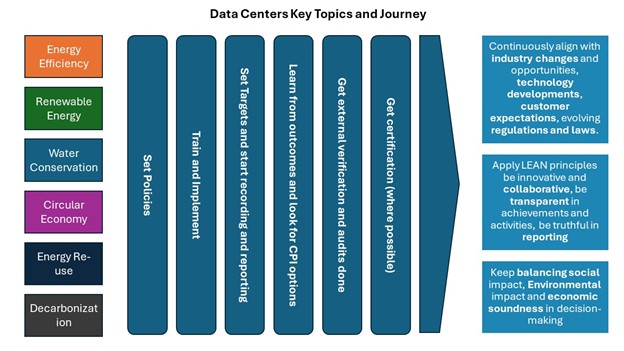
Source: Jo-Ann Garbutt, Digital Realty (2024) during Bureau Veritas webinar[4]. (CPI = Continuing Performance Improvement)
Jo-Ann goes on to say: “Learning and adjusting as we go forward, we have to continuously stay on top of technological developments as well: artificial intelligence, mini-nuclear power facilities, liquid cooling, advancements in long-term data storage solutions are constantly evolving and changing our context. Some of these new technologies impact our energy efficiency approaches. This means while achieving successful outcomes in audits, we have to continue looking for new ways to serve our customers in sustainable ways.”
[1] https://www.techtarget.com/searchdatacenter/feature/Assess-the-environmental-impact-of-data-centers
BBC Panorama “Is the Cloud Damaging our Planet?” https://www.bbc.co.uk/programmes/m001hzb3 & https://uk.nttdata.com/insights/blog/is-the-cloud-damaging-the-planet---a-response-to-panorama
[2] https://www.climateneutraldatacentre.net/signatories/
[3] Updated in 2023 to those which meet two of the following criteria: having under 250 employees, €50m in average annual revenues or €25m of value on their balance sheet
[4] Link to webinar recording - https://www.youtube.com/watch?v=MQNGXwc3OaQ

